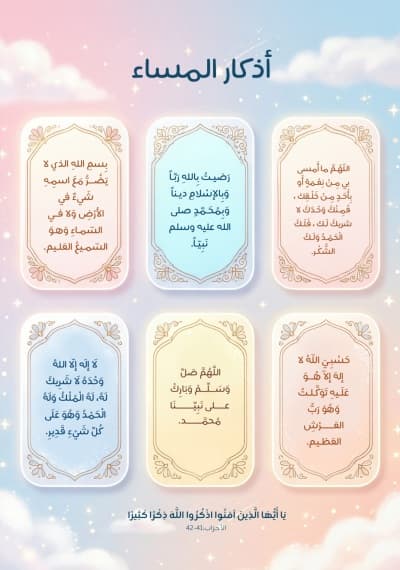
Evening Adhkar Cards to Share Daily

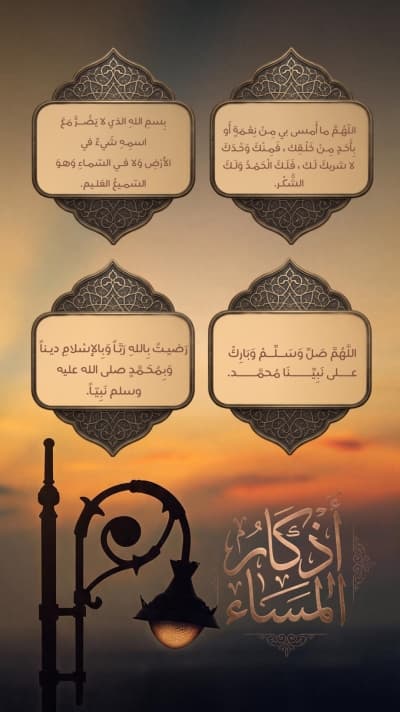
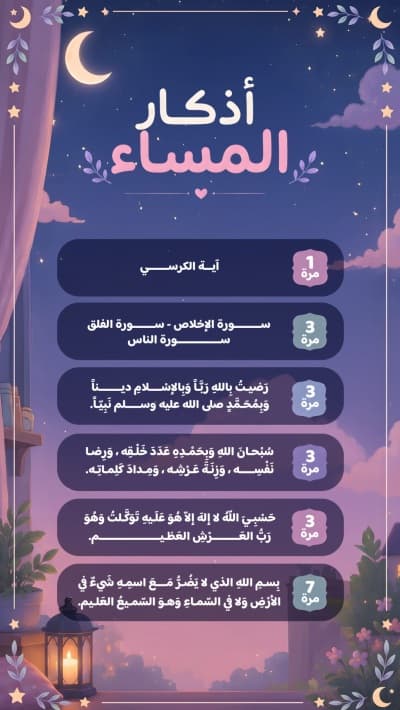
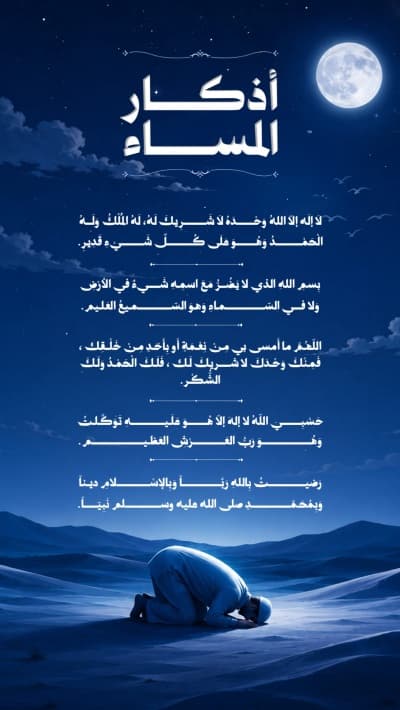
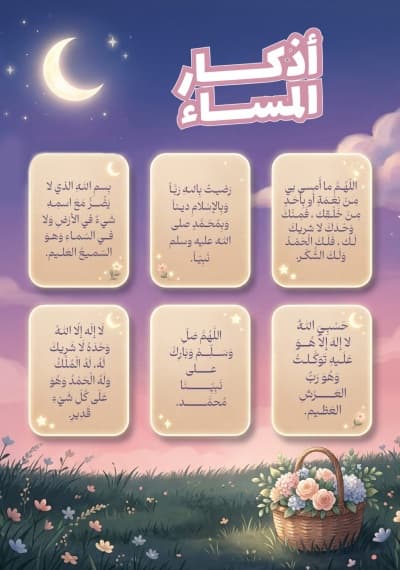
Post the evening adhkar every day. The text sits ready in Arabic with tashkeel on calm night backgrounds, sized for stories and for print.

Start designing
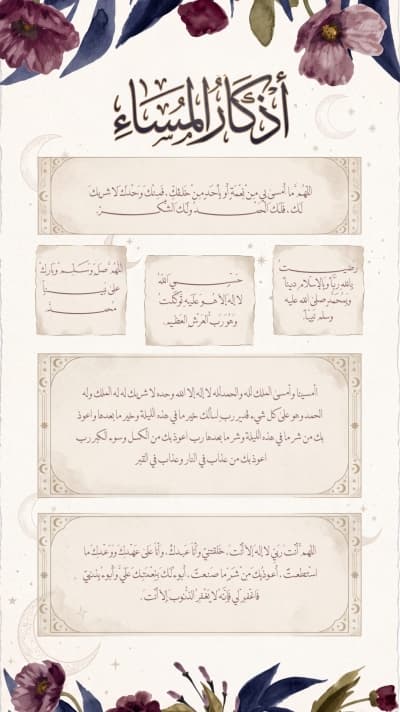
Evening Adhkar Cards

What is different about the evening set?
Night backgrounds and a quieter palette that stays readable in low light, because most people open these at the end of the day. The Arabic text arrives already vocalised.

What can you design?

  • Evening adhkar cards from Hisn al Muslim

  • Sleep adhkar and end-of-day duas

  • An evening series in one fixed identity

  • Posts and stories at ready sizes

  • Printable cards to hang at home

Can you run it as a full series?
Yes. Make the evening cards the counterpart of the morning ones, same layout in a different colour, and a follower can tell which part of the day it is at a glance without reading.

الأسئلة الشائعة

What are the traditional evening adhkar?
They open with Ayat al-Kursi, then Surat al-Ikhlas and the two Muawwidhat three times, then the words acknowledging that evening and dominion belong to God alone, and the supplication that we live and die by Him. Andalusi turns them into a post in a clear script on a night background.
When are the evening adhkar said?
From after the afternoon prayer until sunset, extending into the first third of the night by some scholarly views. Anyone who misses the window may still say them, since consistency matters more than exact timing. Andalusi lets you build a fixed evening post to share daily.
How do morning and evening adhkar differ?
The text is largely the same, with the wording shifting to match the time of day, one naming the morning and the other the evening. The morning set follows the dawn prayer and the evening set the afternoon prayer. Andalusi builds both from one template in two colours so followers tell them apart.
Should I add vowel marks to adhkar in a design?
Yes, since they prevent misreading in reported supplications, but mark only the words that could be misread rather than every letter, or the line crowds. Use a Naskh script, which stays clearest with vowel marks. Andalusi has vocalised adhkar layouts set in Naskh.